Tuesday, February 25, 2014

Not a pretty picture: Mia Feuer's "An Unkindness"


Watching The National on CBC News, I saw Paul Hunter's report on Mia Feuer's art exhibit, An Unkindness, at the Corcoran Gallery of Art, in Washington DC. I knew nothing about this Canadian artist, but, from Peter Mansbridge's introduction and first images, I got hooked.

Well, my getting hooked  on an art exhibit would not be news to anyone that knows me, but I tell you, this one is special, extraordinary. 

As Feuer says: art is not there to change the world but it can certainly make people question it; then act? Hopefully...

I invite you to be the judge, visit the Gallery's site with the announcement to Feuer's exhibition here. The information on the Press Release, which states the programme related to Mia Feuer's show, is also quite telling.

I suggest you watch The National's report, before you visit the gallery site and read the press release.

Not a pretty picture...


Friday, February 21, 2014

Derek Jarman's "Caravaggio" / "Caravaggio" un film de Derek Jarman

Ottavio Leoni, Portrait of Michelangelo Merisi da Caravaggio
c. 1621, Biblioteca Marucelliana, Firenze.[i]

I just revisited the film Caravaggio (1886), directed by Derek Jarman, who also wrote the screen play.

My friend and colleague, Wilder Gómez, with whom I often exchange information and ideas, asked me what I thought of the film. I did not know what to answer; all I could remember was my feeling of awe when the film ended, and the two scenes that stuck in my mind: that of  Caravaggio (Nigel Terry)  lovingly combing the hair of dead Lena (Tilda Swinton), in preparation for the painting of Death of the Virgin,  and  the one of Jerusaleme (Spencer Leigh) crying beside Caravaggio's body and signing his last adieu; they were so moving,  my heart shrank and I was in tears.

During my second viewing this afternoon, I experienced the same emotions; simply said, the film is sublime, a work of art. It kept me captivated for one and a half hours, and I was, once again, moved by the same passages. What I had forgotten is the sombrous contraposition of Caravaggio's death with one of  his best and most poignant paintings, The Entombment.

Caravaggio, La Deposizione di Cristo (c. 1603)
Olio su tela, 300cm x 203cm, Musei Vaticani [ii]

Jarman's motion picture not only narrates  part of Caravaggio's life but also captures and communicates the nature of the painter's baroque style.  The camera shots, as well as the source of light, are often oblique; the screenplay and its characters are so deprived of any idealisation, they can be gruesome; the light is often rendered in the typical caravaggesque chiaro-oscuro, which I take not only as a reference to the artist's style, but also as the filmmaker's reflexion on  human nature. Needless to say, the scriptwriter fills some gaps in Carvaggio's biography and takes some poetic licence but, all through the film, his story remains plausible.  

Thank you Wilder for triggering this new encounter with Derek Jarman's Carvaggio.

----------------------------------------------

Acabo de volver a ver el film Caravaggio (1886) dirigido por Derek Jarman, quien también escribió el guion.

Mi amigo y colega, Wilder Gómez, con quién con frecuencia intercambio información e ideas, me preguntó hoy que pensaba del film. La verdad es que no supe que responder. Vi la película hace años y solamente podía recordar mi sobrecogimiento al final, y las dos escena que más me marcaron: en la primera, Carvaggio (Nigel Terry) peina con mucho amor a Lena (Tilda Swinton) muerta, preparándola para la pintura Muerte de la Virgen, y en la otra, Jerusalén (Spencer Leigh) se despide con señas y llanto de su amo, Caravaggio, esta última es tan conmovedora que me encogió el corazón y se me salieron las lágrimas.

Viendo el film por segunda vez, viví las mismas emociones; simple y llanamente, el film es sublime,  una obra de arte. Me mantuvo cautivada por una hora y media, y una vez más, el pasaje de la muerte de Lena y la despedida de Jerusalén me conmovieron mucho. Lo que había olvidado por completo es la contraposición de la muerte de Caravaggio con una de las mejores pinturas del artista, y la más impactante desde mi punto de vista , el Entierro de Cristo.

Caravaggio, La Deposizione di Cristo (c. 1603)
Olio su tela, 300cm x 203cm, Musei Vaticani [ii]

La cinta de Jarman no solo narra parte de la vida de Caravaggio sino que, al mismo tiempo, captura y comunica el carácter del barroco caravaggesco.  Las tomas de la cámara y la fuente de luz son con frecuencia oblicuas; el guión y sus personajes son tan faltos de idealización que resultan repugnantes con frecuencia; la luz es representada con el típico chiaro-oscuro de Caravaggio, que es fácil interpretar no solo como alusión al estilo del artista, sino también como reflejo de la naturaleza humana. Naturalmente, el cineasta llena algunos vacíos en la historia del pintor y se permite alguna licencia poética, pero la historia es consistentemente y plausible a lo largo del film.

Gracias Wilder por provocar este nuevo encuentro con el Caravaggio de Derek Jarman.


[i]Source: Comune di Milano in:  http://commons.wikimedia.org/wiki/File:Bild-Ottavio_Leoni,_Caravaggio.jpg Retrieved on February, 21, 2014. According to Wikimedia Commons: "This work is in the public domain in the United States, and those countries with a copyright term of life of the author plus 100 years or less." And, "This file has been identified as being free of known restrictions under copyright law, including all related and neighboring rights."
[ii] Source: http://commons.wikimedia.org/wiki/File:The_Entombment_of_Christ-Caravaggio_(c.1602-3).jpg Retrieved: February 21, 2014. According to its source: "This work is in the public domain in the United States, and those countries with a copyright term of life of the author plus 100 years or less." And, "This file has been identified as being free of known restrictions under copyright law, including all related and neighboring rights."

Friday, February 14, 2014

The story of Saint Valentine and the Winter Olympics / La historia de San Valentín y las Olimpiadas de invierno

Saint Valentine (d. February 14, c. 269). Mosaic, n/d.
   Chuch of the Dormition, Jerusalem[i]

Today we celebrate Saint Valentine's day; day of greetings, flowers, romance, dates, engagements, engagement rings, champagne; alas! today we all share, in one way or another, those contemporary symbols that signify friendship and love. Wonderful!

I don't want to "rain on anyone's parade", but, for those interested in History, I share this link to the hagiography of the Saint. 

I hope the story of Valentine's martyrdom, not only opens a window to the History of the Roman Empire, but also calls us to reflection and  inspires tolerance; especially these days when the Winter Olympics are being celebrated in Russia, a country where members of the LGTB community are marginalized, persecuted and prosecuted. As I understand it, we all have the right to love, as long as our love is base on mutual respect and it is constructive.

---------------------------------

Hoy celebramos el día de San Valentín, día de saludos, flores, romance, salidas, pedidas de matrimonio, champagne, anillos; en fin, hoy todos compartimos, en una forma u otra, los símbolos contemporáneos que signifiquen amistad y amor. ¡Lindo!

No quiero arruinarle el día a nadie, pero, para los interesados en Historia, comparto este lazo que relata la hagiografía del Santo. 

Espero que la historia del mártir Valentín, además de abrir una ventanita a la Historia del Imperio romano, nos llame a la reflexión e inspiré tolerancia; especialmente estos días en que los Juegos olímpicos de invierno se llevan a cabo en Rusia, país en el que las personas pertenecientes al colectivo de de la comunidad LGTB son marginados, perseguidos y procesados. Como yo lo entiendo, todos tenemos derecho a amar, siempre y cuando nuestro amor esté basado en el respeto mutuo y sea constructivo. 


[i] Source: http://www.catholic.org/photos/photo.php?news=18661 (CNS Photo/Crosiers) Retrieved: February 14, 2014

Friday, February 7, 2014

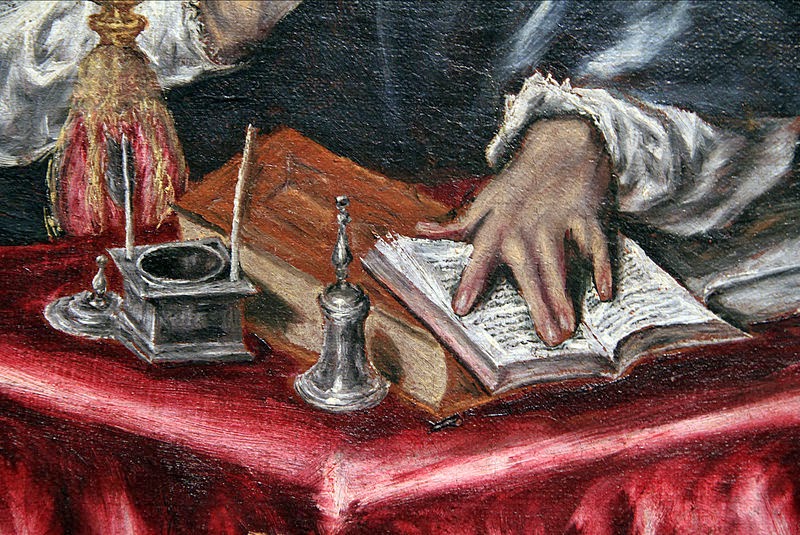
El Greco en el Museo Thyssen / El Greco in the Thyssen Museum

El Greco. Detalle de La visión de San Idelfonso (1600-1604).
 Iglesia del Hospital de la Caridad. Toledo [i]

Visitando el sitio Web del Museo Thyssen para descubrir lo que se puede ver de la muestra de Cézanne recientemente inaugurada por este museo, me encontré con un interesante video presentando el proyecto “El Greco de Italia a Toledo. Estudio técnico dela obras en la colección Thyssen-Bornemisza”. Con este proyecto se conmemora el 400 aniversario de la muerte del pintor griego.

Aquellos interesados en el artista, encontrarán en el vídeo un buen registro visual de su método técnico/ creativo.

La inspección de la muestra de Cézanne queda para más adelante.

Visiting the Thyssen Museum Website, with the objective of seeing something about the recently inaugurated exhibition on Cézanne, I found a very interesting video presenting the project: “El Greco from Italy to Toledo.Technical Study of the Works in the Thyssen-Bornemisza collection.”  With the project, the museum commemorates the 400th anniversary of the Greek painter.

Those interested in the artist, will find the video a good visual registry of his  technical/creative method.

The review of Cezanne’s exhibit will be the subject of an upcoming blog.

[i] Source Wikimedia Commons, according to the source: "The work is in the public domain in the United States and those countries with a copyright term of life of the author plus 100 years or less." In an additional comment Wikimedia Commons adds: "This file has been identified ad being free of known restrictions under copyright law, including all related and neighboring rights". Consulted: February 7, 2014.

Wednesday, February 5, 2014

Homenaje a Violeta Parra

Violeta Parra,  San Carlos 1917 - Santiago 1967 (Chile)[i]
 
Un día como hoy, hace 47 años, murió Violeta Parra,  Violeta fue importante parte de mi crecimiento como ser humano. Mi amada y siempre presente hermana, Bertha Consiglieri Nieri, me introdujo a la música de la poetiza, compositora, cantante y activista chilena.

Violeta, "Dulce vecina de la selva verde / Huésped eterno del abril florido / ... jardinera, locera, costurera... / Poesía, pintura, agricultura / Todo lo haces a las mil maravillas .../ Cocinera, niñera, lavandera, Niña de mano, Todo los oficios .../[ii] Como su hermano Nicanor lo quiso, Violeta ...continúa tejiendo..., continúa construyendo, continúa influyendo la consciencia universal.

A través de la poesía y canciones de Violeta, y del ejemplo de mi hermana, aprendí que lo único que me diferencia de los destituídos es la providencia, la suerte; por lo tanto, el hecho de tener, mal que bien, todo lo necesario y más constituye una obligación. Obligación de utilizar la voz procurando la tolerancia, la justicia, la hermandad; a mi modo, y espero, en todos los aspectos de mi vida.

Violeta, como muchos otros seres muy sensibles, se quitó la vida. ¿Porqué? Nunca lo sabremos; ella se llevó el secreto. Hay quienes dicen que murió de amor, otros piensan que el dolor punzante de la vida la llevó a matarse. Cualquiera que fuese su razón, la respeto. Doy "Gracias a la vida", y a Berthi,  por la oportunidad de haber conocido la música, la poesía y el pensamiento de Vioeta Parra.

"La Jardinera" está  entre mis canciones preferidas de la gran folklorista chilena.


[i] Fotografía publicada en la revista argentina "Panorama" en 1973. Fuente: http://www.magicasruinas.com.ar/revdesto016.htm. 
De acuerdo a Wikipedia: "This image is in the public domain because the copyright of this photograph, registered in Argentina, has expired. (Both at least 25 years have passed after the photograph was created, and it was published at least 20 years ago, Law 11.723, Article 3, as amended, and Berne Convention Article 7 (4).)" Source: http://en.wikipedia.org/wiki/File:Parra01f.PNG, consulted: February 2, 2014.
[ii] Extractos del poema "Defensa de Violeta Parra" de Nicanor Parra. Para escuchar el poema completo recitado por Mercedes Sosa presione aquí. 


Tuesday, January 21, 2014

Jacob Burckhardt's THE CIVILIZATION OF THE RENAISSANCE IN ITALY


                                    Cover page of Jacob Burckhardt's The Civilization of the Renaissance in Italy,                                                translated by S. G. C. Middlemore in 1878. [i]

For those who love to read and are interested in the development of knowledge and ideas in general, and in Renaissance culture in particular, a copy of the second edition of Jacob Burckhardt's The Civilization of the Renaissance in Italy (1860), translated by S. G. C. Middlemore in 1878, is avaible through the Gutenberg Project here

The second edition is of special interest for, as the redactor's note states, although there are many print runs after the latter, this one is the last edition that contains material, ideas or data entered by Burckhardt. 

There is another 'copy' of the same edition available on the Web which has an interesting and accurate introduction by Melissa Snell; it can be found here. As Sneel proposes,[iii] although many of the ideas presented by Burckhardt have been fittingly challenged, The Civilization of the Renaissance in Italy remains a very valuable source for those who want to explore Renaissance and Italian culture.

[i] Source: http://upload.wikimedia.org/wikipedia/commons/2/28/Die_Kultur_der_Renaissance_in_Italien_.jpg                             (Captured: 01/21/2014) According its source, "This image (or other media file) is in the public domain because its                    copyright has expired."
[ii] Source: Adobe Digital Editions: Jacob Burckhardt's The Civilization of the Renaissance in Italy, translated by S. G. C.         Middlemore in 1878, p. 5. at http://www.gutenberg.org/ebooks/2074 (Consulted: 01/16/2014)
[iii] Source: http://historymedren.about.com/od/burckhardt/a/cri_main.htm (Consulted: 01/21/2014)

Monday, January 6, 2014

Beauty in Nature: the 2013 Ice Storm

Butternut tree.

It's been a difficult, and busy, few weeks. Not because I get caught in the consumerist Christmas craze, or because we have an intensive social life during the Holidays, but because this year we are having a particularly hard winter.  This means clearing huge amounts of snow, taking longer to get to and fro anywhere, being housebound at times because the roads are treacherous  and, occasionally, spending sometime in the dark. No electricity: no heat and, oh no! no Internet. 

For some, specially for my South-American friends and family, this may be hard to believe but, in Southern Ontario, these extreme circumstances are rare. However, this year, the wintry time has proven to be a challenging one.

A street in Port Hope, ON.

So far, the event of the season in Ontario has been the Ice Storm of 2013.

An ice storm occurs when the atmospheric pressure is low and two slow moving and drastically different, temperature wise, systems collide. In North America the phenomenon takes place when the warm Gulf air meets the frigid Arctic air. This could happen anywhere in a territorial stretch from Northern Texas to Newfoundland.[i]

Just a couple of days before Christmas, temperatures verged around the freezing mark when  the storm began. By now, it is well known that hundreds of thousands of people were affected by the storm in some way. Some had a very hard time with no electricity for as long as two weeks. I cannot fathom the consequences for all the animals and the environment around us.

I do not mean to make light of what was true hardship for so many people and all sorts of creatures,  but, as with  many things in life, there was a dichotomy here: this very difficult event was also one that produced some of the most beautiful sights I have ever seen. I leave you with some images I captured in Port Hope and Mitchell's Corner on Christmas Eve. 

Mulberry bush

Wisteria.

Taking stock of the magnificent view.

The view.

Grass row.

Idem, detail.

Bushes.

Lonesome little tree.

Branch detail.